
Going through a difficult season can feel even heavier when it seems like no one around you truly understands what you are experiencing.
A job loss, family pressure, financial hardship, caregiving responsibilities, emotional stress, or another major life transition can affect more than one part of daily life. Sometimes professional help is necessary. At other times, people may also benefit from having a respectful place to talk, listen, connect, and learn from others who understand similar challenges.
Peer support groups bring people with shared or similar experiences together to offer encouragement, understanding, practical perspective, and connection. They are not a replacement for therapy, medical care, or crisis services, but they can provide a form of community support that is different from facing challenges alone.
The World Health Organization describes peer support groups as groups where people with similar concerns can explore shared challenges and support one another through the understanding that comes from lived experience.
For individuals and families in DeSoto and surrounding communities, MT Hope House incorporates peer connection and wellness circles into its broader Hope & Wellness Initiative, a nonclinical program focused on emotional wellness, personal development, life skills, healthy coping, and stronger support systems.
This guide explains how peer support groups work, what someone can expect, what research says about their benefits, how they differ from therapy, and when a different level of support may be more appropriate.
What Is a Peer Support Group?
A peer support group is a community-based setting where people with shared experiences or similar concerns can connect, listen to one another, exchange perspective, and offer mutual encouragement.
The word peer is important.
Peer support is built around the idea that someone who has experienced a similar challenge may understand parts of that experience differently from someone approaching it only from a professional or outside perspective.
That does not mean every group member has lived through exactly the same circumstances. It means there is enough common experience to create understanding and meaningful conversation.
WHO notes that peer groups can create social connections that might not otherwise develop and allow participants to support one another around shared challenges.
Peer support may be organized around mental health recovery, grief, caregiving, family challenges, addiction recovery, chronic illness, major life transitions, or broader experiences of hardship and stress.
What Is a Wellness Circle?
“Wellness circle” is not one standardized clinical term used the same way by every organization.
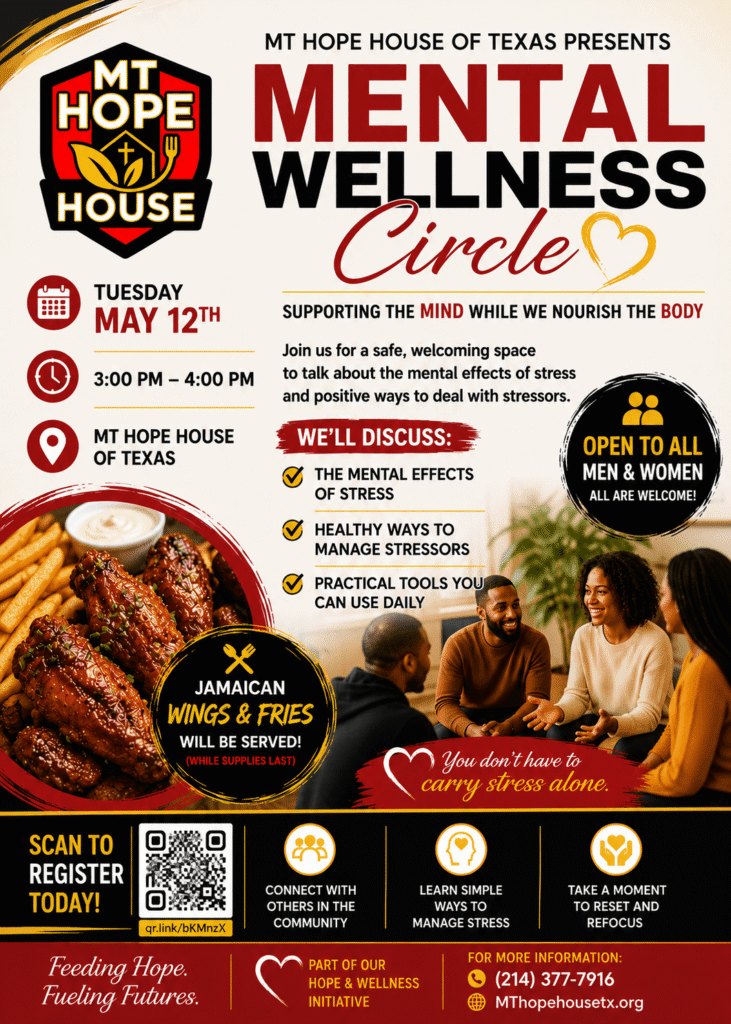
At MT Hope House, wellness circles are supportive community settings where participants can reflect, connect with others, receive encouragement, and feel less isolated during difficult seasons. They are part of the organization’s Hope & Wellness Initiative and are designed as nonclinical support rather than therapy or medical treatment.
This distinction helps separate the two ideas.
A peer support group emphasizes connection among people who may understand similar life experiences. A wellness circle at MT Hope House provides a broader space for reflection, encouragement, emotional awareness, and community connection.
The two approaches can overlap, but they do not need to be identical.
How Do Peer Support Groups Work?
Peer support groups work by creating a structured or semi-structured environment where people can connect around shared experiences.
The exact format depends on the group. Some are peer-led, while others have a trained facilitator, nonprofit staff member, community leader, or other moderator helping guide discussion.
Participants may talk about current challenges, share experiences, listen to others, discuss coping approaches, exchange practical ideas, or simply spend time with people who understand what they are going through.
Mayo Clinic explains that support groups often give participants opportunities to share experiences, discuss concerns, exchange coping strategies, and learn useful information from others facing related situations. (mayoclinic.org)
A healthy group should not pressure participants to disclose more than they are comfortable sharing. Listening can also be a meaningful form of participation.
What Should You Expect at a Peer Support Group?
It is normal to feel uncertain before attending a support group for the first time.
A well-run group should make its purpose and expectations clear. Depending on the program, a meeting may begin with introductions or a short explanation of group guidelines. Participants may then have opportunities to discuss a topic, share an experience, respond to a question, or listen to others.
Before joining, it is reasonable to ask about the facilitator, meeting format, group purpose, participation expectations, privacy guidelines, cost, accessibility, and whether professional mental health care is involved.
Mayo Clinic specifically recommends asking about the organizer’s training, confidentiality expectations, group rules, typical meeting format, and whether the group fits your needs and values
At MT Hope House, the Hope & Wellness Initiative is built around conversation, encouragement, practical learning, and community connection. Participants may take part in wellness circles, peer support, stress-management activities, goal-setting, personal development, and life skills development.
Adults interested in strengthening practical abilities alongside emotional wellness can also explore how life skills training helps adults build independence.
What Are the Potential Benefits of Peer Support Groups?
The value of peer support often begins with connection.
When someone is under stress, being around people who understand similar experiences may reduce the feeling that they have to explain everything from the beginning or handle every difficulty alone.
Potential benefits can include feeling heard, meeting people with relatable experiences, gaining new perspectives, learning practical coping ideas, discovering helpful resources, strengthening social connection, and receiving encouragement during difficult periods.
Mayo Clinic notes that support groups may help people feel less isolated or judged, talk more openly about concerns, learn coping approaches, and find information about useful health or social resources.
Those benefits should not be presented as guaranteed clinical outcomes. Different people respond differently to peer support, and the quality, format, leadership, population, and purpose of a group can all affect the experience.
What Does Research Say About Peer Support?
Research suggests peer support can be valuable, but the evidence is more nuanced than simply saying that support groups “work.”
A systematic review and meta-analysis involving 30 randomized controlled trials and 4,152 participants found that peer support interventions were associated with small improvements in clinical and personal recovery outcomes.
The researchers also cautioned that the quality of many included studies was modest and that effects were not equally strong across all outcomes.
Research focused specifically on group peer support has also found possible small improvements in overall recovery, while evidence for outcomes such as symptoms, empowerment, and hope has been mixed or limited.
A broader umbrella review reached a similar conclusion: some reviews found improvements in self-reported recovery, but the quality of evidence varied considerably.
For readers, the practical takeaway is simple.
Peer support can be a meaningful part of a broader support system, but it should not be promoted as a guaranteed treatment or a substitute for appropriate professional care.
That is also how MT Hope House positions its Hope & Wellness Initiative. The program provides community-based, nonclinical wellness support and does not claim to replace licensed therapy, medical care, or clinical counseling.
Peer Support Groups vs. Group Therapy: What Is the Difference?
Peer support and group therapy may both involve people meeting and discussing shared challenges, but their purpose and structure are different.
- Peer support groups focus primarily on mutual understanding, shared experience, encouragement, practical perspective, and community connection. They may be peer-led or facilitated by someone who helps guide the group.
- Group therapy is a form of professional mental health treatment. It is led by a qualified mental health professional and is organized around therapeutic goals, clinical methods, or treatment needs.
NAMI describes peer support groups as settings built around understanding and empathy between peers, while therapy groups involve professional observation, interpretation, and therapeutic intervention. (my.nami.org)
Someone may benefit from peer support and therapy at the same time. Choosing one does not automatically exclude the other.
The important question is whether the type of support matches the person’s actual needs.
Who Might Benefit From Peer Support?
Peer support may be useful for adults who feel isolated, are navigating a major transition, are under sustained stress, are supporting a family member, are recovering from a difficult period, or simply want to connect with others who may understand similar experiences.
A person does not necessarily need a diagnosis to value community connection.
At MT Hope House, the Hope & Wellness Initiative may support individuals and families experiencing economic hardship, personal stress, family pressure, low confidence, life instability, or a need for stronger support systems.
Sometimes peer connection is only one part of what someone needs. Financial pressure, employment challenges, housing concerns, food insecurity, transportation, or family responsibilities may all contribute to stress.
MT Hope House’s Community Outreach & Resource Navigation program helps individuals and families better understand their needs and explore appropriate community resources when available.
Readers dealing with several challenges at once may also find the guide on where families can find support beyond food assistance helpful for understanding how community services can work together.
This creates an important distinction between supporting someone and trying to solve every problem within one program.
What Should You Look for in a Safe and Supportive Group?
Not every group will be the right fit for every person.
Before participating, consider the purpose of the group, who facilitates it, whether participation is voluntary, how privacy is handled, and whether the group stays within appropriate boundaries.
A supportive group should encourage respect rather than judgment. It should not pressure members into sharing private information, buying products, following questionable medical advice, or replacing needed professional treatment.
Mayo Clinic identifies concerns such as poor privacy practices, disruptive group dynamics, misinformation, and groups promising certain cures as warning signs to consider. (mayoclinic.org)
It is also important to understand that confidentiality expectations in a peer setting are not the same as legal or professional confidentiality in every healthcare relationship. Group members can agree to respect privacy, but participants should understand the group’s rules before sharing highly sensitive information.
When Peer Support Is Not Enough
Peer support is valuable, but there are circumstances where professional or immediate help is more appropriate.
Someone experiencing a mental health crisis, suicidal thoughts, immediate danger, severe symptoms, or another urgent behavioral health concern should not rely on a community peer group as the only source of help.
In the United States, the 988 Suicide & Crisis Lifeline provides 24/7 support by call, text, or chat with trained crisis counselors. SAMHSA states that 988 can support people experiencing suicidal, mental health, substance-use, or other emotional crises. (samhsa.gov)
If there is immediate physical danger or a medical emergency, call 911 or go to the nearest emergency department.
For non-emergency situations where someone is unsure which type of support may be appropriate, MT Hope House’s Community Outreach & Resource Navigation program may help identify relevant community or mental health referral options. It does not replace licensed care or emergency services.
Peer Connection at MT Hope House
MT Hope House of Texas serves DeSoto, surrounding communities, and the greater Dallas area as a Community Resource Hub.
Its broader approach connects food assistance, workforce development, education, resource navigation, community partnerships, and wellness support to help individuals and families move toward greater stability.
Through the Hope & Wellness Initiative, participants can explore wellness circles, peer support groups, life skills workshops, stress-management support, goal-setting activities, personal development, family discussions, and leadership opportunities in a respectful, nonclinical environment.
The purpose is not to turn community support into therapy.
It is to give people another place to connect, learn practical tools, build healthier support systems, and identify the next step when life feels difficult to manage alone.
Frequently Asked Questions About Peer Support Groups
What is a peer support group?
A peer support group brings together people with similar experiences or concerns so they can share perspective, encouragement, practical ideas, and mutual support.
How do peer support groups work?
Formats vary, but groups often involve guided or peer-led discussion, listening, shared experiences, encouragement, and practical conversation around common challenges. Participation and meeting structure depend on the organization.
What are the benefits of peer support groups?
Possible benefits include greater social connection, shared understanding, encouragement, practical perspective, reduced feelings of isolation, and opportunities to learn from others. Benefits vary by person and group.
Are peer support groups the same as therapy?
No. Peer support focuses on shared experience and mutual support. Group therapy is professional mental health treatment led by a qualified clinician.
Do I have to talk during a peer support group?
Not necessarily. Group expectations vary, but people should generally be able to participate at a level that feels appropriate rather than being pressured to share personal information.
Are peer support groups confidential?
Groups may establish privacy and confidentiality expectations, but rules differ. Ask how privacy is handled before sharing sensitive information, and remember that peer-group confidentiality may not carry the same protections as professional healthcare confidentiality.
What is a wellness circle?
At MT Hope House, a wellness circle is a supportive community setting where participants can reflect, connect, receive encouragement, and strengthen emotional awareness in a respectful, nonclinical environment. Learn more through the Hope & Wellness Initiative.
Does MT Hope House offer peer support in DeSoto, Texas?
Yes. MT Hope House includes peer support groups and wellness circles within its Hope & Wellness Initiative in DeSoto. Availability may vary, so interested participants should contact the organization for current program information.